

In our daily lives, we do not often have the opportunity to be deeply aware of air safety. However, in emergency situations such as disasters, terrorism, and war, toxic substances in the air pose a serious risk to human life.
Against such "invisible threats," the key words in the field of disaster prevention and defense are CBRNE." や NBC." This concept is known as "the These are generic terms for chemical, biological, radioactive, and other hazardous elements, and are used by military and disaster management agencies around the world as a framework for countermeasures. This article will explain the terms, taking into account their history and how they are used.
What is NBC - The "Triple Threat" created during the Cold War
What is "NBC"?Nuclear, Biological、Chemical The term is an acronym for "WMD". During the Cold War, weapons of mass destruction (WMD) such as nuclear, chemical, and biological weapons became a major concern for the international community, and the term became established to refer to defense and disaster prevention systems against these weapons.
NBC weapons are all characterized by 'cause widespread damage,' 'invisible,' and 'create secondary damage.' This is the common denominator of the two types of weapons. Chemical weapons spread through air and water, while biological weapons spread from person to person through infection. Nuclear weapons cause long-term environmental contamination through the dispersal of radioactive materials.
Common to all of these is the medium of "air,Risk of entry into the human body through breathing It is.
From NBC to CBRNE - Terminology Evolution Shows Changing Risk Environment
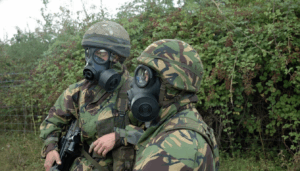
From NBC to CBRN and then CBRNE
With the end of the Cold War, the security environment of the international community has changed dramatically. In addition to weapons development by states, a more diverse range of threats have emerged, including terrorism, accidents, and radiation contamination.
This led to "NBC" in the 1990s. Radiological plus CBRN." was used, and furthermore, in the 2000s Explosive plus CBRNE." has become the international standard terminology.
This terminology expansion is not a mere replacement of words,Diversification of risks and expansion of scope of response to non-military disasters This means. For example, factory explosions, radiological leaks, the spread of viral infections, and terrorist explosions are also covered by CBRNE.
CBRNE" is common today
Present,NATO, national defense agencies, and international disaster response organizations uses the term "CBRNE defense". In Japan, the term "CBRNE" or "CBRN" is becoming more common in materials from the National Institute for Defense Studies (NIDS) and the Self Defense Forces, as well as in academic papers related to disaster prevention in Japan. This is not merely a military term,Disaster preparedness, anti-terrorism, medical protection, infrastructure protection This is because it is defined as a comprehensive crisis management framework that includes
In other words,NBC is Cold War Threat Perception, CBRNE is Contemporary Comprehensive Crisis Response This is the position of the company.
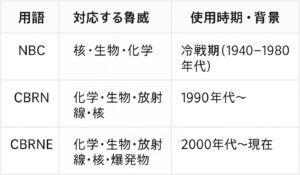
Thus, "CBRNE" is aNew standards for disaster prevention and protection against the diverse hazardous risks of modern societyThe company is positioned as a
Difference between R (Radiological) and N (Nuclear)
Even within CBRNE, "R" (radiation) and "N" (nuclear) look similar, but the nature of the hazard assumed is different. R=Radiological means contamination by radioactive materials themselves. It does not involve nuclear reactions, but is mainly the case when a medical or industrial radiation source is spread by accident or terrorism. The so-called "Dirty Bomb" is a typical example, in which radioactive contamination and psychological disruption are more problematic than the power of the explosion.
on the other hand N = Nuclear is a fission and fusionA situation where the nuclear reaction itself occurs.refers to
Like a nuclear weapon explosion or nuclear reactor accident, it is characterized by enormous heat, blast, and radiation, causing widespread and long-term damage.
Briefly,
- R is for "the threat of contamination from the spread of radioactive materials."、
- N is "the combined threat of destruction and radiation from nuclear reactions."。
An important point that separates the two is that even in the same area dealing with "radiation," they differ greatly in scale, cause, and effect.
Why “air purification” is the key to CBRNE countermeasures
Of the CBRNE, damage related to Chemical (Chemical), Biological (Biological), and Radiological (Radiological) in particular is,Enters the human body through the air In other words, "protecting the air" is directly related to "protecting life. In other words, "protecting the air" is directly related to "protecting life.
In evacuation centers, hospitals, government facilities, and even disaster prevention centers such as the Self-Defense Forces, fire departments, and police departments,CBRNE-compliant air purification and ventilation systems are in demand. General air purifiers are effective in removing pollen and PM2.5, but are inadequate in protecting against chemical agents, radioactive particulates, bacteria, and viruses.
Therefore,Disaster Prevention Ventilation System" combining high-performance filters and air pressure control technology is required.
Protecting Lives from CBRNE with Domestically Produced Technology - "AT Barrier" Series

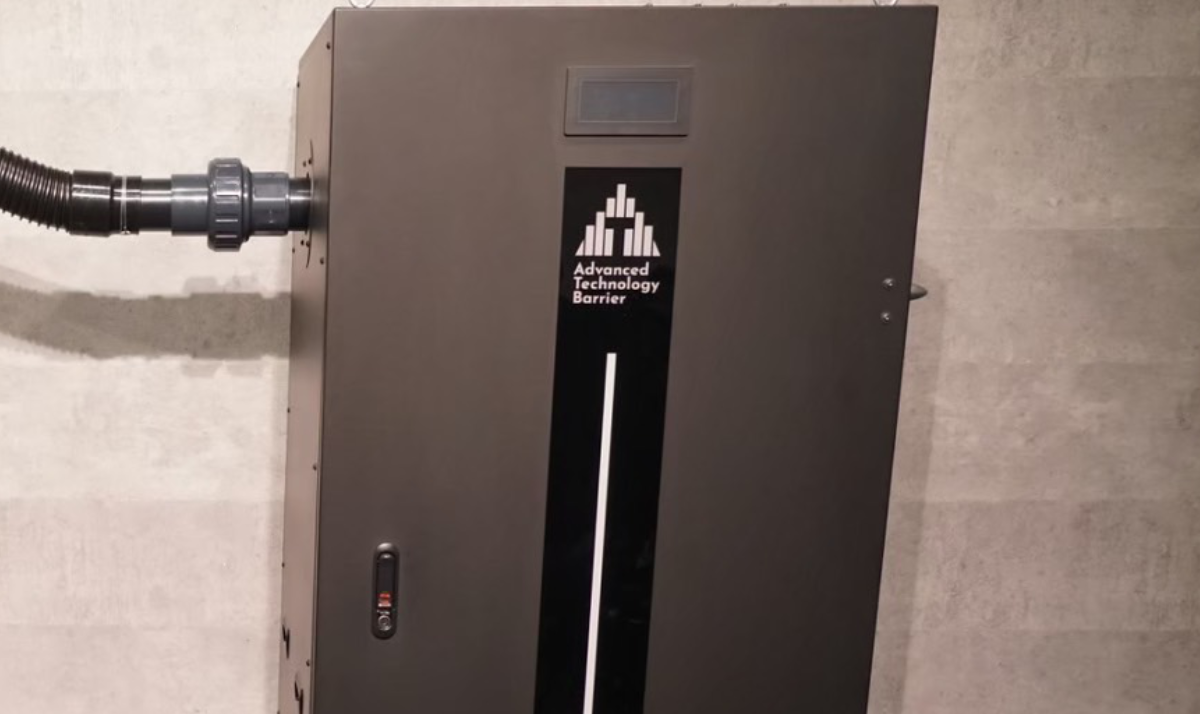
Our company has developed this kind of “air defense”. Disaster Ventilation System "AT Barrier" Series It is. The AT barrier was designed to be a CBRNE countermeasure.Air purification and ventilation unit for disaster prevention made in Japan and employs a unique multi-layer filter structure that efficiently removes harmful substances.
- Adsorbs chemical agents and radioactive particles Special activated carbon filter
- Traps particulate and biological aerosols HEPA Filter
- Controls the difference in air pressure between indoors and outdoors, preventing contaminated air from entering the room. Positive and negative pressure control function
This allows for "breathing space in a CBRNE environment," which is not possible with ordinary air purifiers. In addition, by designing the unit to operate even during power outages,Disaster sites, medical facilities, evacuation centers, government facilitiesIt is also suitable for operations such as
AT Barrier 150 and AT Barrier Lite - Situational Disaster Prevention Solutions
The standard model, AT Barrier 150, is a high-power model designed for large evacuation spaces and disaster prevention centers. Its powerful filtering performance enables it to be operated for long periods of time and to protect large spaces.
The new AT Barrier Lite model, on the other hand, is,Compact, lightweight, portable This model is designed with an emphasis on "safety" and can be quickly installed in limited spaces, such as temporary evacuation spaces during disasters or at medical sites.
Small but CBRNE compliant."That is the concept behind the AT-Barrier Lite. The AT-Barrier Lite is easy to use, even for the average user, and allows air safety to be protected without specialized knowledge.
Preparing for Invisible Threats
The term CBRNE may sound like a distant world from a Japanese perspective. However, who could have predicted 10 years ago that we would be at war in the Middle East or Russia as of 2025? Such is the world situation now,Ensure air safety." It is clear that this is a disaster-prevention issue in Japanese society.
The "AT Barrier" series is designed to prepare for such a modern CBRNE environment,Creating “life-preserving air” with domestic technology It is a solution.